What is PM2.5?
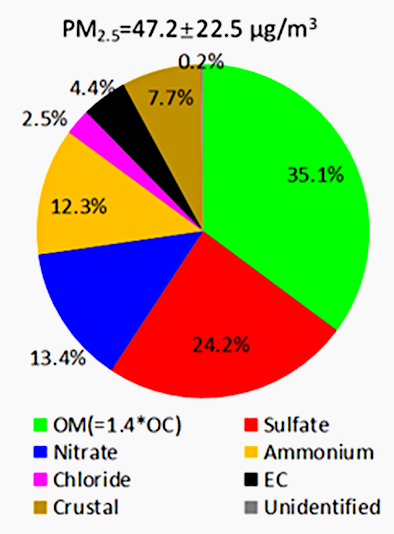 Fine particulate matter (PM2.5) is a major air pollutant that harms health and impairs visibility. PM2.5 was introduced as a criteria pollutant in Hong Kong in 2014. Different from criteria gaseous pollutants, PM2.5 is a complex mixture containing inorganic ion, elemental carbon, tens of thousands of individual organic compounds, and metal oxides. The multiple layers of complexity mean that PM2.5 mass concentration alone is insufficient to identify contributing sources or to attribute a reduction in PM2.5 to a particular control measure. The chemical composition information is essential in evaluating the sources and evolution of PM2.5 pollution.
What we do
We present here a data set of the chemical composition of PM2.5 spanning ten-year (2008-2017) and covering three sites in the Pearl River Delta. Such a long time series of PM2.5 data are rare in China and elsewhere in Asia. Over the decade, the PM2.5 pollution dropped at a rate of 1.5-3.0 µg m-3 yr-1 at the three sites. This decrease had contributions from all major components of PM2.5, including sulfate, ammonium, nitrate, organic matter, and elemental carbon. The measurement data has unambiguously verified the effectiveness of vehicular emission controls and SO2 reduction in lowering PM2.5 pollution in our region.
Additional PM2.5 chemical composition data in Hong Kong and the Pearl River Delta will be added to this web portal as they become available.
Project Lead - Contact
Professor YU, Jian Zhen
Email: jian.yu@ust.hk
Phone: 852-2358-7389
Mailing Address: Division of Environment & Sustainability, HKUST, Clear Water Bay, Kowloon, Hong Kong, China